Tuesday, February 10, 2009
Dinosaur Fractions
This is what we call "Dinosaur Fractions". Christian,(6 years of age) loves playing with his dinosaurs. Somehow as we were playing restaurant with the dinosaurs, there was a need to explain fractions. From this point on he always asks to play dinosaur fractions and now he really knows his fractions!!!
This was a natural approach to learning. It evolved out of our play. :)
Here is how it works - We start with one dinosaur in the restaurant. Another dinosaur approaches. We only have 1 sandwich in the restaurant. First we must count how many dinosaurs we have and then figure out how may parts we need to divide the sandwhich to feed the dinosaurs. We pass out the labeled fraction parts to the dinosaurs. We show how the individual fraction parts equal a whole and then clean up. In comes, the next dinosaur. Now instead of two dinosaurs we have 3 and it keeps going all the way up to 10 dinosaurs.
In the picture above, we had 4 dinosaurs in the restaurant. So, we had to divide the sandwich into 4 equal parts.
Here, you can see how we show that 4/4 equal one whole.
Here are all the other fraction parts we use. These are magnetic fractions. I'll have to remember where I bought them and I'll post it.
Dinosaur Fractions
This is what we call "Dinosaur Fractions". Christian,(6 years of age) loves playing with his dinosaurs. Somehow as we were playing restaurant with the dinosaurs, there was a need to explain fractions. From this point on he always asks to play dinosaur fractions and now he really knows his fractions!!!
This was a natural approach to learning. It evolved out of our play. :)
Here is how it works - We start with one dinosaur in the restaurant. Another dinosaur approaches. We only have 1 sandwich in the restaurant. First we must count how many dinosaurs we have and then figure out how may parts we need to divide the sandwhich to feed the dinosaurs. We pass out the labeled fraction parts to the dinosaurs. We show how the individual fraction parts equal a whole and then clean up. In comes, the next dinosaur. Now instead of two dinosaurs we have 3 and it keeps going all the way up to 10 dinosaurs.
In the picture above, we had 4 dinosaurs in the restaurant. So, we had to divide the sandwich into 4 equal parts.
Here, you can see how we show that 4/4 equal one whole.
Here are all the other fraction parts we use. These are magnetic fractions. I'll have to remember where I bought them and I'll post it.
Montessori Metal Insets
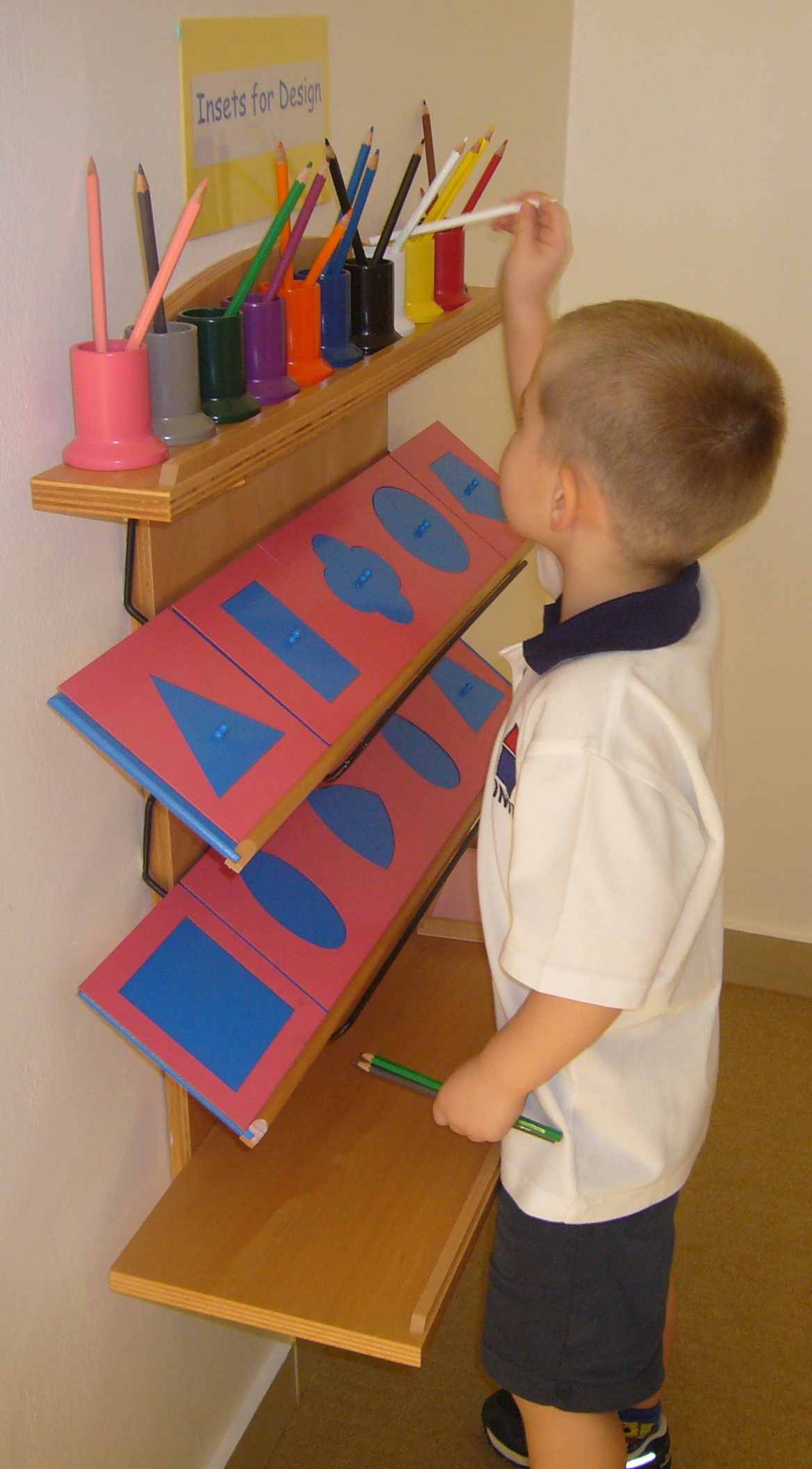
There are 10 geometrical shapes. The frame is one color and the inset is a diffrent color. The ten shapes are: rectangle, triangle, curvilinear triangle, circle and ellipse on the top rack. On the bottom rack is the quatrefoil, pentagon, square, trapezium and the oval. Some, might find it strange that young children are being introduced to some advanced geometric shapes.
Although the direct aim is preparation for handwriting, the children are being introduced to shapes that they eventually will have to learn anyway. Instead of using silly shapes or designs, Maria Montessori is always thinking ahead! Children love to draw. They are preparing there little hands for the complexities of handwriting and learning geometric shapes!
The general age for this work is between 3-6. (Joshua will be 3 in May)
The aim of this work is to help the child acquire proficiency in using a writting instrument, including lightness of touch, evenness of pressure, continuity of line, control of line, and familiarity with the curves and angles found in letters.
To pick up the inset out of its holder requires the "pincer grip". A lot of the Montessori materials used in the 3-6 classroom, utilize this pincer grip. The child, without even knowing it, is strengthening and preparing there little hands for future handwriting. In traditional schools, children complain that there hands hurt while practicing printing or children's handwriting is poor because their little hands are not adequately prepared for this type of work. You will find with Montessori, that each work prepares the child for the next work.
Joshua is holding the pencil a little too high.
I gave him the first presentation of this work today. In Montessori, you never correct, you observe the child. I noted the observation and I will model the work again or he will see his brother doing this work and he will self-correct himself. If I correct him, I will disturb his train of thought, I will also crush his confidence in doing things himself. I will also teach him to look to me to see if he is doing it right. I can actually cultivate a need for approval. I want him to experience the joy of his work and to give him the opportunity to develop the self confidence of knowing himself if he is doing it right.
Keep in mind, the child does an activity for the joy and satisfaction of it, not to please the adult or for the adults approval . . .We must be lovingly careful not to interfere with praise and or criticism. Just observe the work, ask questions about the work.
I know it is hard and it sounds strange. It was a difficult change for my husband and myself.
Montessori Metal Insets
There are 10 geometrical shapes. The frame is one color and the inset is a diffrent color. The ten shapes are: rectangle, triangle, curvilinear triangle, circle and ellipse on the top rack. On the bottom rack is the quatrefoil, pentagon, square, trapezium and the oval. Some, might find it strange that young children are being introduced to some advanced geometric shapes.
Although the direct aim is preparation for handwriting, the children are being introduced to shapes that they eventually will have to learn anyway. Instead of using silly shapes or designs, Maria Montessori is always thinking ahead! Children love to draw. They are preparing there little hands for the complexities of handwriting and learning geometric shapes!
The general age for this work is between 3-6. (Joshua will be 3 in May)
The aim of this work is to help the child acquire proficiency in using a writting instrument, including lightness of touch, evenness of pressure, continuity of line, control of line, and familiarity with the curves and angles found in letters.
To pick up the inset out of its holder requires the "pincer grip". A lot of the Montessori materials used in the 3-6 classroom, utilize this pincer grip. The child, without even knowing it, is strengthening and preparing there little hands for future handwriting. In traditional schools, children complain that there hands hurt while practicing printing or children's handwriting is poor because their little hands are not adequately prepared for this type of work. You will find with Montessori, that each work prepares the child for the next work.
Joshua is holding the pencil a little too high.
I gave him the first presentation of this work today. In Montessori, you never correct, you observe the child. I noted the observation and I will model the work again or he will see his brother doing this work and he will self-correct himself. If I correct him, I will disturb his train of thought, I will also crush his confidence in doing things himself. I will also teach him to look to me to see if he is doing it right. I can actually cultivate a need for approval. I want him to experience the joy of his work and to give him the opportunity to develop the self confidence of knowing himself if he is doing it right.
Keep in mind, the child does an activity for the joy and satisfaction of it, not to please the adult or for the adults approval . . .We must be lovingly careful not to interfere with praise and or criticism. Just observe the work, ask questions about the work.
I know it is hard and it sounds strange. It was a difficult change for my husband and myself.
Sunday, February 8, 2009
Montessori homeschooling resources
Lisa Nolan Montessori - I have used her Montessori activities. Great for a beginning Montessori mom!
Former Montessori teacher.
Designed for parents, homeschoolers & teachers who want to incorporate Montessori into their home, classroom, or daycare setting. These activities are easy to download & save to your computer. The programs and activities are homeschool friendly.
Lisa is happy to give email consulting to parents and guardians who want to teach Montessori at home or as an addition to their other curricula.
http://http//www.montessorifortheearth.com/
Montessori teacher with Montessori lessons on video and many pdf files for your use for home!
http://www.montessorimaterials.org/
Montessori teacher who offers all of her pdf files for a minimum price. I use her pdf files!
http://www.montessoriforeveryone.com/
Former Montessori teacher.
Designed for parents, homeschoolers & teachers who want to incorporate Montessori into their home, classroom, or daycare setting. These activities are easy to download & save to your computer. The programs and activities are homeschool friendly.
Lisa is happy to give email consulting to parents and guardians who want to teach Montessori at home or as an addition to their other curricula.
http://http//www.montessorifortheearth.com/
Montessori teacher with Montessori lessons on video and many pdf files for your use for home!
http://www.montessorimaterials.org/
Montessori teacher who offers all of her pdf files for a minimum price. I use her pdf files!
http://www.montessoriforeveryone.com/
Subscribe to:
Posts (Atom)